
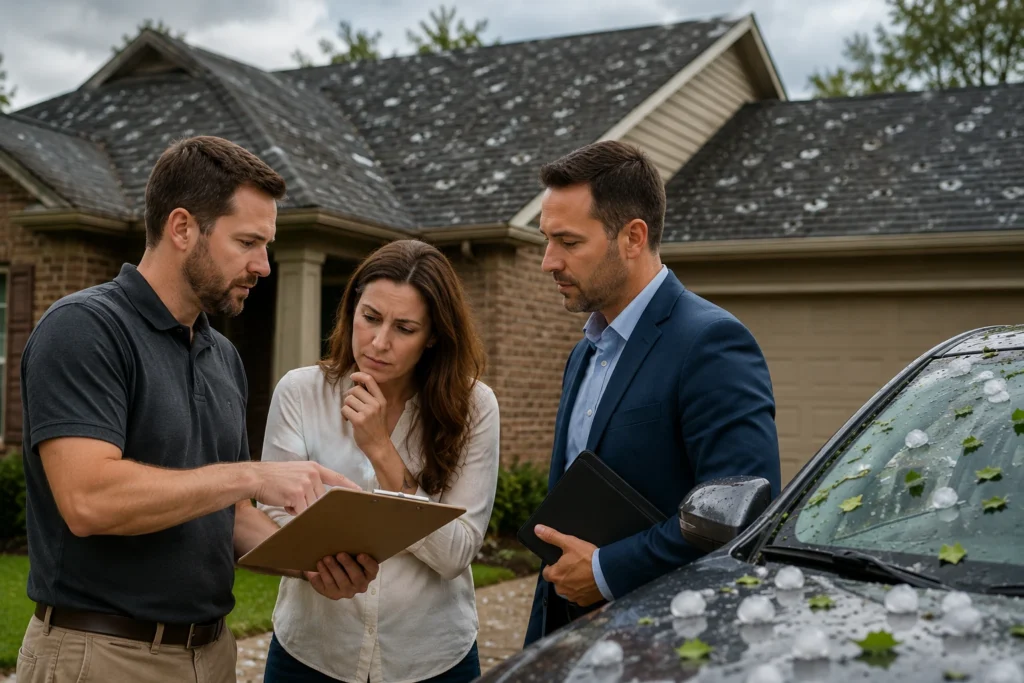
Hail season in Texas changes everything fast. One storm rolls through, and suddenly homeowners are staring at dented gutters, bruised shingles, ceiling stains, and confusing insurance paperwork. That is exactly why understanding Public Adjuster vs. Insurance Adjuster for Hail Claims in Carrollton, TX matters before you start signing documents or approving repairs. Most homeowners assume the claims process is straightforward. Sometimes it is. Sometimes it absolutely is not.
A carrier adjuster may inspect the roof and approve thousands less than what contractors later say is necessary. A public adjuster may identify missing line items the original estimate overlooked. Contractors may disagree with the scope entirely. Then supplements begin. Reinspections happen. Weeks disappear. It gets messy quickly! The good news? Once you understand how each professional operates, the process becomes far easier to navigate. You can ask sharper questions. You can organize evidence better. You can avoid common claim mistakes that cost homeowners money every single year.
This guide breaks it all down clearly. No fluff. No confusing language. Just practical insight into how hail claims actually work and how homeowners can protect themselves when damage hits.
Understanding Hail Damage Claims in Texas
Texas consistently ranks among the most hail-prone states in the country. Roofing contractors know it. Insurance carriers know it. Property owners definitely know it. And hail damage is not always obvious from the ground.
Some roofs look perfectly fine until close inspection reveals fractured matting beneath shingles, displaced granules, damaged ridge caps, or compromised flashing systems. Water intrusion may not appear immediately either. Months can pass before leaks begin showing inside the home. That delay creates problems. Insurance companies often scrutinize late-reported hail claims more aggressively because they may argue the damage came from aging, wear, or maintenance issues rather than a specific storm event.
Common Types of Hail Damage
Different roofing systems react differently after storms. Here are some of the most common damage categories adjusters evaluate:
| Roofing Component | Common Hail Damage |
| Asphalt shingles | Bruising, granule loss, cracking |
| Metal roofing | Dents, coating damage |
| Tile roofing | Fractures, edge chipping |
| Gutters | Dents and separation |
| Flashing | Bending or punctures |
| Skylights | Cracking or seal failure |
| Window screens | Impact tearing |
Even small overlooked items can matter financially. A few missing accessories on a scope sheet can create thousands in additional repair costs later. That is where the differences between adjusters become important.
What Is an Insurance Adjuster?
An insurance adjuster works for the insurance company. Their job is to inspect damage, interpret policy coverage, and estimate what the carrier believes should be paid on the claim. That does not automatically make them “bad.” Many are skilled professionals doing difficult work under intense time pressure. But their role is still tied directly to the carrier. That distinction matters.
Types of Insurance Adjusters
There are usually three categories homeowners encounter after hailstorms:
Staff Adjusters
These adjusters are direct employees of the insurance company.
Independent Adjusters
These are third-party contractors hired by carriers during high claim volume periods.
Catastrophe Adjusters
Often deployed after major storm events when thousands of claims flood into the system quickly.
After severe storms, catastrophe adjusters may inspect multiple properties per day across large regions. Time pressure becomes enormous. And yes, that can influence inspection depth.
What Insurance Adjusters Typically Do During Hail Claims
The inspection process usually includes:
- Exterior roof inspection
- Photographing damage
- Measuring roof dimensions
- Identifying affected elevations
- Reviewing collateral damage
- Preparing an estimate
- Applying depreciation and deductibles
Sounds simple enough. But problems often begin during the estimate-writing phase.
Some adjusters produce highly detailed scopes. Others miss critical components entirely.
For example:
- Starter shingles may be omitted
- Flashing replacement may be excluded
- Ridge vent quantities may be incomplete
- Drip edge requirements may be overlooked
- Code upgrades may not appear initially
These omissions are one reason supplemental claims become common after hail losses.
What Is a Public Adjuster?
A public adjuster represents the policyholder, not the insurance company. That is the single biggest distinction in the Public Adjuster vs. Insurance Adjuster for Hail Claims in Carrollton, TX discussion.
Public adjusters are licensed professionals hired by property owners to assist with claim preparation, documentation, negotiation, and settlement support. Instead of protecting the carrier’s interests, they advocate for accurate evaluation of the loss from the policyholder’s perspective.
What Public Adjusters Typically Handle
A public adjuster may:
- Inspect the property independently
- Review policy language
- Analyze carrier estimates
- Identify missing scope items
- Organize documentation
- Submit supplemental requests
- Coordinate reinspections
- Negotiate claim revisions
This becomes especially valuable when claims are disputed or underpaid.
Why Estimates Often Differ
Homeowners are often shocked when contractor estimates, public adjuster estimates, and carrier estimates vary dramatically. But there are reasons for that.
Commonly Missed Items in Hail Claims
| Frequently Missed Item | Why It Matters |
| Ice and water barriers | Required by some code situations |
| Flashing replacement | Essential for watertight systems |
| Ridge vent replacement | Ventilation performance |
| Starter shingles | Required installation component |
| Steep roof charges | Increased labor difficulty |
| Waste calculations | Material ordering realities |
| Drip edge | Code compliance in many areas |
One estimate may include all these items. Another may exclude half of them. Suddenly a $12,000 roof replacement estimate becomes $21,000. That gap creates conflict.
Public Adjuster vs. Insurance Adjuster for Hail Claims in Carrollton, TX
This comparison matters because homeowners often misunderstand who represents whom.
Here is the clearest way to think about it:
| Factor | Public Adjuster | Insurance Adjuster |
| Represents | Homeowner | Insurance carrier |
| Goal | Accurate policyholder settlement | Carrier claim evaluation |
| Compensation | Percentage of settlement | Paid by insurer |
| Scope review | Often highly detailed | Varies |
| Negotiation role | Strong involvement | Carrier-directed |
| Supplemental focus | Common | Reviews submitted requests |
Neither role automatically guarantees a better outcome. But understanding incentives helps homeowners evaluate advice more carefully.
Why Hail Claims Become Disputed
Most disputes are not dramatic courtroom battles. They are usually disagreements over scope, pricing, or causation.
And they happen constantly.
Partial Roof Approval Problems
Insurance carriers sometimes approve repairs instead of full replacement.
Homeowners then face questions like:
- Will repaired shingles match?
- Is the roof actually repairable?
- Will the warranty remain intact?
- Are discontinued materials involved?
These are not small concerns. A roof system functions as an integrated structure. If repairs compromise performance or appearance, disputes often escalate quickly.
Denied Hail Claims
Denials frustrate homeowners more than almost anything else in property insurance.
Common denial reasons include:
- Wear and tear findings
- Mechanical damage arguments
- Lack of storm-created openings
- Insufficient documentation
- Delayed reporting
- Cosmetic damage exclusions
Sometimes denials are legitimate. Sometimes they are challenged successfully with better documentation. That distinction is critical.
The Documentation Advantage
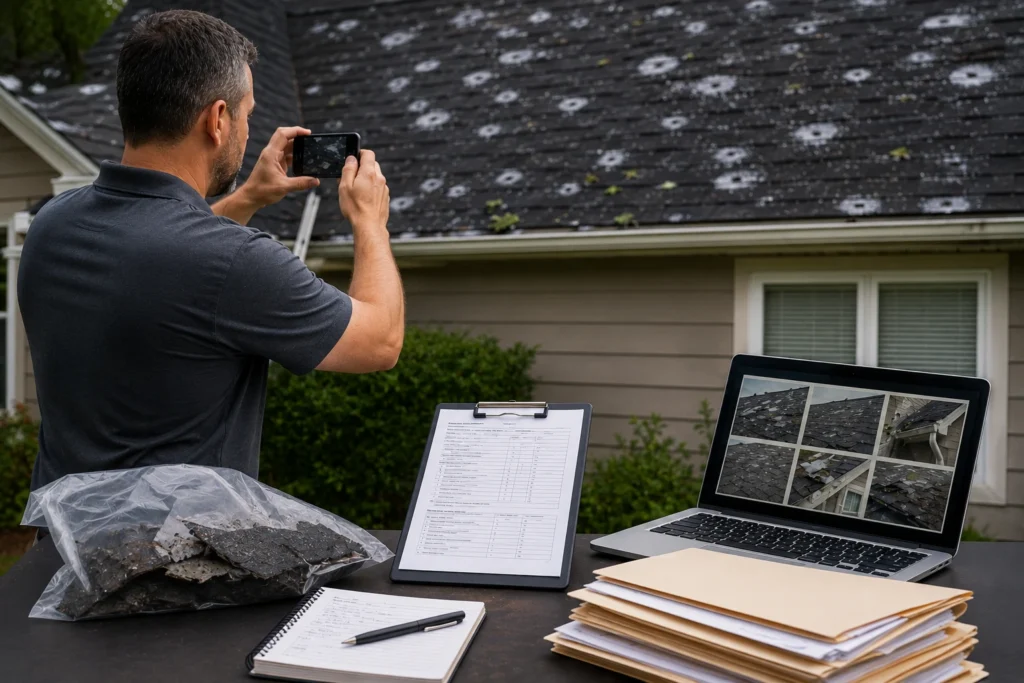
The strongest hail claims are usually the best documented ones. Not the loudest. Not the angriest. The most organized.
Effective Documentation Often Includes:
- Wide-angle roof photos
- Close-up impact images
- Interior leak documentation
- Weather event verification
- Contractor inspection reports
- Moisture readings
- Date-stamped images
- Drone imagery
Good documentation changes conversations fast. Instead of arguing emotionally, homeowners present evidence systematically. That is far more effective.
How Public Adjusters Strengthen Claims
A strong public adjuster often focuses heavily on scope completeness.
That means identifying every legitimate repair component tied to restoring the property properly.
Examples of Supplement Categories
| Supplement Item | Why It Appears |
| Code upgrades | Local building requirements |
| Additional roofing layers | Tear-off complications |
| Flashing replacement | Water protection |
| Interior paint blending | Matching concerns |
| Detach and reset items | HVAC, solar, gutters |
Some supplements are completely justified. Others may be disputed. But thorough documentation improves credibility dramatically. Many disputes begin because the original estimate fails to include critical roofing components, code-required items, or hidden damage discovered during construction. This is why experienced professionals spend time reviewing Hail Damage Claim Supplements: What Carriers Miss in Their Scope before repairs begin. Missing flashing, ventilation upgrades, starter materials, and detach-and-reset items can significantly affect the true restoration cost of a hail-damaged property. In some ways, complex claim analysis resembles concepts found in Topological vector space, where multiple interconnected variables influence the overall structure and outcome.
The Role of Contractors in Hail Claims
Roofing contractors influence claim outcomes more than many homeowners realize. Experienced contractors often spot missing items quickly because they understand installation realities firsthand.
That perspective matters. An estimate may look complete on paper while still missing critical operational components required during actual construction.
Contractors Often Identify:
- Ventilation deficiencies
- Flashing complications
- Steep roof access challenges
- Decking deterioration
- Code-triggered upgrades
This is one reason supplements happen so frequently after roofing work begins.
Situations Where Insurance Adjusters Alone May Be Enough
Not every claim requires a public adjuster. That is important to say clearly. Sometimes the insurance process works efficiently from the start.
Examples
- Small uncomplicated claims
- Straightforward roof replacements
- Responsive insurance carriers
- Detailed initial scopes
- Cooperative reinspections
If the estimate is fair and communication remains strong, homeowners may not need additional representation. And honestly, many claims do resolve smoothly.
Situations Where Public Adjusters Become Valuable
The opposite is also true. Some claims become highly technical and difficult.
Public Adjusters Often Help Most When:
- Claims are denied
- Roof systems are expensive
- Commercial properties are involved
- Multiple buildings were damaged
- Carrier estimates appear incomplete
- Large supplements are disputed
- Interior water damage becomes extensive
Time matters too. Busy property owners may not have hours available for inspections, paperwork, phone calls, estimate reviews, and supplement coordination. Public adjusters often absorb much of that workload.
Understanding Supplemental Claims
Supplements are one of the most misunderstood parts of hail claims. A supplement is simply a request to revise the original estimate based on additional findings. That is it. Supplements are not automatically fraudulent. They are common because initial inspections occur under limited conditions.
Legitimate Supplement Reasons
- Hidden flashing damage
- Additional tear-off requirements
- Code upgrades
- Material pricing changes
- Unseen water damage
- Ventilation corrections
Some carriers handle supplements cooperatively. Others scrutinize every line item aggressively. Preparation matters.
Communication Mistakes Homeowners Make
Many homeowners unintentionally weaken their own claims.
Common Mistakes
Waiting Too Long
Delays create causation disputes.
Throwing Away Damaged Materials
Preserved evidence can matter later.
Accepting Verbal Statements as Final
Always request written documentation.
Failing to Read the Estimate
Many homeowners never review the scope carefully.
Choosing Contractors Too Quickly
Storm-chasing contractors create additional risks.
Slow down. Review everything. A few extra days of diligence can prevent months of frustration.
Questions Homeowners Should Ask Insurance Adjusters
Good questions improve claim clarity immediately.
Helpful Questions Include:
- Was code coverage evaluated?
- Were all roof accessories included?
- Is matching addressed?
- Was ventilation reviewed?
- Were steep charges considered?
- What caused excluded items?
- Can supplements be submitted later?
Specific questions force more detailed conversations. That helps everyone.
Questions Homeowners Should Ask Public Adjusters
Public adjusters should also be vetted carefully.
Important Questions
| Question | Why It Matters |
| Are you licensed in Texas? | Legal compliance |
| What is your fee structure? | Financial clarity |
| How do you document supplements? | Professional process |
| Have you handled hail claims locally? | Experience relevance |
| Will you attend reinspections? | Involvement level |
Professional transparency matters enormously in this industry.
Red Flags to Watch For
Not every contractor, adjuster, or consultant operates professionally.
Watch carefully for:
- Unrealistic settlement promises
- High-pressure contracts
- Extremely vague scopes
- Refusal to provide documentation
- Aggressive fear tactics
- “Sign now” sales pressure
Strong professionals explain things clearly. Weak ones create urgency and confusion. Big difference.
Why Local Conditions Matter in Carrollton
Storm behavior varies regionally. Roofing systems vary too. Homes in Carrollton may experience different hail exposure patterns depending on roofing age, neighborhood construction styles, wind direction, and prior storm history.
Older roofing systems may already have underlying vulnerabilities before hail arrives. That can complicate claim evaluation because carriers may argue pre-existing deterioration contributed to failures. That is where detailed inspections become extremely important in Carrollton properties.
Understanding Roof Repair vs. Replacement
One of the biggest claim disputes centers around repairability. Insurance carriers may argue repairs are sufficient. Contractors or public adjusters may argue replacement is necessary.
Factors Affecting Repairability
- Shingle availability
- Color matching
- Roof age
- Fragility during repairs
- Manufacturer guidelines
- Local code requirements
These debates become technical fast. Documentation and manufacturer guidance often influence outcomes heavily.
Appraisal Clauses and Escalation
Some disputed claims eventually move into appraisal. Appraisal is not a lawsuit. It is a contractual dispute-resolution mechanism many Texas policies contain.
Generally:
- The homeowner selects an appraiser
- The carrier selects an appraiser
- An umpire may resolve disagreements
This process usually focuses on pricing and scope disagreements rather than outright coverage disputes. Not every claim reaches this stage. But homeowners should know appraisal exists.
Texas Prompt Payment Rules
Texas has regulations governing claim handling timelines.
Carriers are generally expected to:
- Acknowledge claims promptly
- Investigate reasonably
- Request necessary information
- Accept or deny claims within statutory timelines
- Pay approved amounts promptly
Understanding these timelines helps homeowners monitor delays more effectively.
Real-World Claim Scenarios
Scenario 1: Smooth Approval
A homeowner experiences clear hail damage after a major storm. The insurance adjuster performs a detailed inspection, approves full replacement quickly, and supplements remain minimal. This absolutely happens.
Scenario 2: Underpaid Estimate
The original estimate excludes flashing, ridge vents, steep charges, and code upgrades. Contractor documentation and supplemental review later increase the settlement substantially. Also common.
Scenario 3: Denied Claim Reopened
The carrier initially attributes damage to wear and tear. Additional weather documentation, contractor evidence, and reinspection support lead to partial or full approval later. Again, not unusual. Every claim evolves differently.
How to Organize a Strong Hail Claim
Here is a practical approach homeowners can follow immediately after storm damage.
Step-by-Step Checklist
- Photograph all visible damage
- Document the storm date
- Schedule a professional inspection
- Preserve damaged materials if possible
- Review the insurance policy
- Request a copy of the carrier estimate
- Compare contractor findings carefully
- Organize all communications in writing
- Track deadlines and inspections
- Submit supplements with evidence
Organization wins claims more often than emotion.
Choosing the Right Path After Hail Damage
The right decision depends on claim complexity. Some homeowners only need a trustworthy contractor and responsive carrier. Others may benefit from additional representation if disputes grow larger. The key is evaluating the situation honestly.
Ask Yourself:
- Is the estimate detailed?
- Was communication professional?
- Were obvious damages missed?
- Is the carrier responsive?
- Are contractors identifying major scope gaps?
- Is the roof system complex?
- Are repairability questions unresolved?
Those answers usually point homeowners in the right direction.
Advanced Claim Challenges That Often Change Settlement Outcomes
Many hail claims appear simple during the first inspection. Then the real complexity shows up later. A contractor begins removing shingles and discovers deteriorated decking. Flashing damage becomes more extensive than originally visible. Ventilation components fail inspection standards. Interior moisture appears weeks after the storm.
Suddenly the original estimate no longer reflects the actual restoration cost. This is one reason experienced professionals spend so much time discussing “scope accuracy.” A claim is not just about visible dents on a roof. It is about restoring the property correctly and safely.
Hidden Damage Creates Major Problems
Some forms of hail damage are easy to spot immediately. Others are subtle.
For example:
- Microfractures in shingles may weaken waterproofing over time
- Metal flashing may separate slightly without obvious visual tearing
- Sealants around penetrations may fail after impact stress
- HVAC systems may suffer fin damage that reduces efficiency
- Skylight seals may weaken long before leaks become visible
Homeowners who rely only on quick visual observations from the ground often underestimate the seriousness of storm damage. That becomes risky later.
Why Roof Age Matters During Hail Claims
Roof age influences nearly every major conversation during the claims process. Older roofs create additional scrutiny because insurance carriers may argue deterioration existed before the hail event. Contractors, meanwhile, may argue hail accelerated functional failure beyond repairability. Both sides may partially agree while still disagreeing on the settlement value.
Older Roofs Often Create Questions About:
| Roofing Issue | Why It Matters |
| Brittle shingles | Repairs may cause further damage |
| Discontinued materials | Matching becomes difficult |
| Prior repairs | Causation disputes emerge |
| Existing wear | Coverage disagreements increase |
| Ventilation deficiencies | System performance concerns |
These issues are especially important in neighborhoods with aging roofing systems where multiple storms have occurred over several years.
The Psychology of Insurance Claim Stress
Most homeowners file very few major property claims during their lifetime. Insurance professionals handle them constantly. That experience imbalance matters more than people realize.
Homeowners are usually stressed, frustrated, busy, and unfamiliar with technical estimating language. Meanwhile adjusters, contractors, and consultants operate inside this environment every day. That is why organization becomes such a powerful advantage.
Practical Ways to Reduce Claim Stress
- Keep all documents in one folder
- Save every email communication
- Photograph repairs before work begins
- Request written explanations for denials
- Avoid verbal-only agreements
- Track inspection dates carefully
Small habits create enormous clarity later. And clarity reduces costly misunderstandings.
Why Reinspections Frequently Happen
Reinspections are common after hail claims. Very common. A contractor may dispute the original carrier scope. A public adjuster may identify additional damage. The insurance company may request another inspection to evaluate supplemental requests. This process can feel frustrating to homeowners because it extends timelines. But reinspections also create opportunities to correct incomplete evaluations.
Reinspections Often Focus On:
- Additional roof slopes
- Interior damage expansion
- Flashing systems
- Code-related upgrades
- Collateral evidence
- Repairability concerns
- Material matching
Preparation during reinspections matters enormously. The strongest presentations are usually organized, calm, and evidence-based rather than confrontational.
How Technology Has Changed Hail Claims
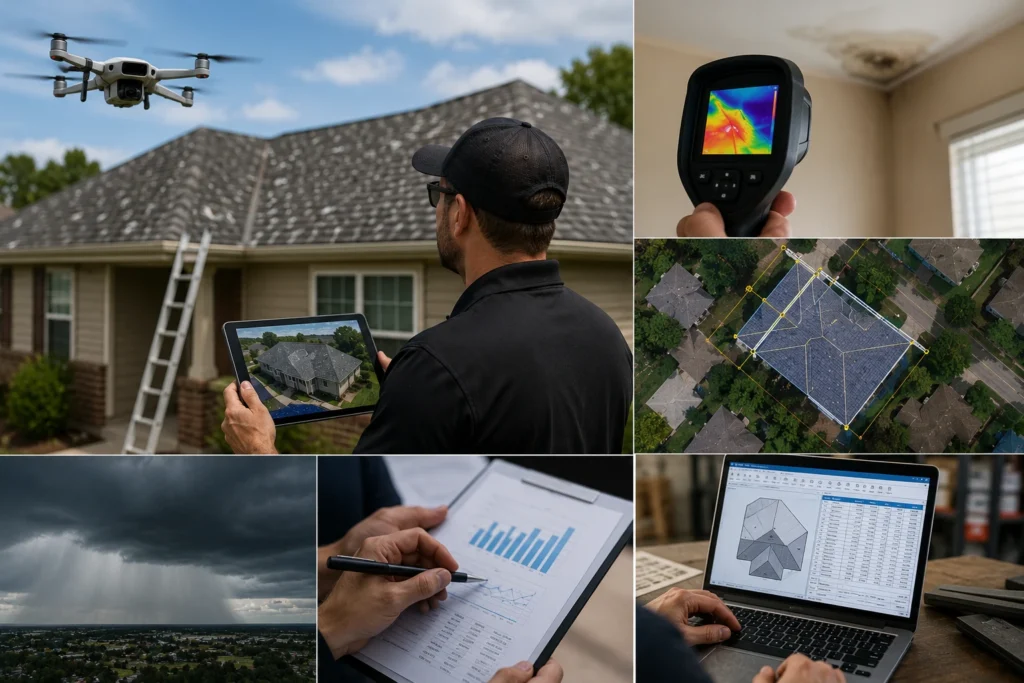
Modern hail claims look very different compared to ten or fifteen years ago. Technology now influences almost every stage of the process.
Common Technology Used During Claims
| Technology | Purpose |
| Drone inspections | Safer roof imaging |
| Moisture mapping | Detect hidden water intrusion |
| Satellite measurements | Roof dimension calculations |
| Weather verification reports | Storm-date validation |
| Digital estimating software | Scope and pricing analysis |
These tools improve documentation significantly when used correctly. But technology alone does not guarantee accurate outcomes. Human interpretation still matters. A detailed drone image means little if critical damage indicators are overlooked.
The Importance of Professional Communication
Claim outcomes are often influenced by communication quality more than homeowners expect. Aggressive arguments rarely improve negotiations. Detailed evidence usually does. That distinction matters.
Strong professionals focus on:
- Documentation
- Policy language
- Scope clarity
- Repair requirements
- Supporting photographs
- Consistent communication
Weak communication creates unnecessary friction. Strong communication keeps claims moving forward productively even during disagreements.
Why Some Hail Claims Take Months to Resolve
Homeowners are often surprised by how long complex claims can last.
Several factors contribute to delays:
Common Delay Sources
- High regional claim volume
- Inspection scheduling backlogs
- Supplemental disputes
- Material availability issues
- Interior damage expansion
- Contractor scheduling
- Appraisal discussions
After major storms, carriers may process thousands of claims simultaneously. That volume strains everyone involved, including contractors and adjusters alike. Patience becomes important. But so does persistence. Following up consistently without becoming disorganized is usually the most effective approach.
Public Adjuster vs. Insurance Adjuster for Hail Claims in Carrollton, TX: Why Education Matters
The biggest advantage homeowners can gain is education. Not legal threats. Not social media arguments. Not panic. Education. Once property owners understand how the claims process works, they make stronger decisions at every stage. They understand why supplements appear. They recognize why estimates differ. They learn how documentation influences negotiations. That knowledge changes outcomes. And in complex storm situations, informed homeowners are usually far harder to overwhelm or pressure into rushed decisions.
For anyone evaluating Public Adjuster vs. Insurance Adjuster for Hail Claims in Carrollton, TX, the most important step is not choosing a side immediately. It is understanding the process thoroughly enough to determine what level of assistance the claim truly requires. That perspective alone can save homeowners enormous time, stress, and financial frustration after severe hail damage.
Public Adjuster vs. Insurance Adjuster for Hail Claims in Carrollton, TX: Final Thoughts
The conversation around Public Adjuster vs. Insurance Adjuster for Hail Claims in Carrollton, TX is not really about choosing sides. It is about understanding roles, incentives, documentation, and claim complexity. Insurance adjusters evaluate claims for carriers. Public adjusters advocate for policyholders. Contractors identify installation realities. Supplements bridge scope gaps. And homeowners sit in the middle trying to make informed decisions during stressful situations. That is why preparation matters so much.
The strongest hail claims are rarely built on pressure tactics or emotional arguments. They are built on organized evidence, detailed inspections, accurate estimating, professional communication, and persistence. Homeowners who understand the process tend to make better decisions. They ask sharper questions. They recognize missing scope items faster. They avoid rushing into poor agreements. And most importantly, they place themselves in a far stronger position to restore their property properly after storm damage occurs. When hail strikes, clarity becomes valuable. Very valuable.
FAQs
A public adjuster represents the policyholder, while an insurance adjuster represents the insurance company during the claim process.
It depends on the complexity of the claim. Public adjusters are often helpful for denied, underpaid, or large hail claims.
Yes. Claims may be denied due to insufficient evidence, wear and tear findings, or policy exclusions.
Supplements are requests to add missed damage or additional repair costs to the original insurance estimate.
Simple claims may resolve in weeks, while disputed or complex claims can take several months.
They inspect shingles, flashing, gutters, vents, siding, windows, and interior leak areas for storm-related impacts.
Yes. Homeowners can provide contractor documentation, request reinspections, or submit supplemental estimates.
Often, yes. Contractors and public adjusters may coordinate documentation and scope reviews during the claim process.
Take photos, document the storm date, schedule an inspection, and notify your insurance carrier promptly.
Yes. Severe Texas storms frequently produce hail damage that affects residential and commercial roofing systems.